Mitsubishi Tech Support

  • Subscribe to our RSS feed.
  • Twitter
  • StumbleUpon
  • Reddit
  • Facebook
  • Digg

Wednesday, 14 September 2011

Fukushima Daiichi: Reactor buildings

Posted on 13:15 by Unknown
Two types of brief updates on the reactor buildings at Fukushima Daiichi.

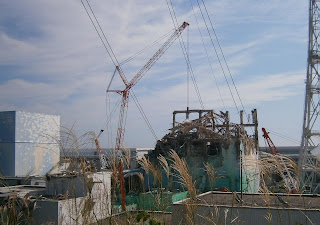
First, the steel framework has been completed for the "first type" or fabric panelled enclosure at No. 1 reactor building. In fact, as of this moment the panels are already going on. See below a shot, courtesy TEPCO, of the completed framework. Click to enlarge.


Second, dust sampling is being performed over the reactor buildings to determine just what kinds of particles are being sent into the atmosphere. First, a shot of the sampling device with its fabric hood; note the workmen's feet visible below the hood for a sense of scale.


Below we see the device being used on September 11th above No. 1 reactor building:


Below we see the device being used on September 12th above No. 3 reactor building:

Be sure to see today's earlier update concerning water injection to the three reactors at Fukushima Daiichi, and the accompanying video at the APR YouTube Channel.

4:22 PM Eastern Wednesday September 14, 2011
ATOMIC POWER REVIEW
Read More
Posted in "fukushima daiichi", "TEPCO" | No comments

Fukushima Daiichi: Reactor water injection

Posted on 12:46 by Unknown
TEPCO will be very shortly beginning water injection to the No. 2 plant's reactor through the core spray line, exactly as has already been done with No. 3 plant. The amount will be adjusted upward incrementally through the core spray line and reduced through the feed line to attempt to maintain constant temperature with reduced water flow - the idea being to reduce the feed line more than the core spray line adds. This moves toward the goal of keeping temperature low and minimizing the buildup of contaminated water.

Multiple sources of water, and multiple pumps are available. In the best TEPCO press video yet, the entire setup as it is right now is explained in good detail and shown in detail. Maps are used to show site locations. See the newest video on the APR YouTube channel now; it is already on line and is at this moment the featured video.

Click here to get to the APR YouTube channel.

3:50 PM Eastern Wednesday September 14, 2011
ATOMIC POWER REVIEW
Read More
Posted in "fukushima daiichi", "TEPCO", "video" | No comments

Monday, 12 September 2011

The Rabid Media - and the Marcoule incident

Posted on 13:16 by Unknown
From time to time, I like to do the sort of thing you're about to see me do. I always thank Fintan Dunne for putting me on to this. Let's go!

First, look at the headline of the following article:

"What You Need to Know About the Nuclear Explosion In France."

There was no nuclear explosion in France. There was an industrial accident involving a furnace used to melt contaminated metal parts together into ingots for disposal. While this could involve, say, a fossil fuel explosion there isn't even a nuclear reactor in the facility in question.. and even THEN, there could not be a nuclear explosion because reactors cannot explode like nuclear weapons. So this has to be one of the most highly exaggerated headlines yet.

Here is just a horrible headline, and an even worse article:

France aims to limit fallout from nuclear accident.

Where shall I begin?

-Clever use of the word "fallout" hints at radioactive fallout, but they really mean public reaction to the event.

-Note the use of the different serious scary words such as "blast" and "blown up."

-See the implication that the press has learned from anti-nuclear Fukushima press hack media guidelines vis a vis age of sites in this article when it mentions that this is one of the oldest nuclear sites in France. This is one of their new hot button things - age.

-Note how the article ends with "hasn't learned the lessons of Fukushima." Yes, well, lessons learned from one of the most massive natural disasters in modern times and how that relates to GE-Toshiba-Hitachi boiling water reactors in Mk I containment buildings really has little to do with an explosion and fire in and around a furnace that melts steel.

"Blast rocks nuclear plant in France."

It's not a nuclear plant. It's a waste processing facility. Can't we get a handle on the differences here, media? Please? What, do I need to issue you all a media guide? Nuclear energy 101, maybe I'll call it. By the way - don't even bother reading the article actually linked above because it's almost perfect in its incorrectness from front to back, top to bottom. It's a masterpiece of total inaccuracy.

"Jitters after nuclear accident in France."

The Voice of Russia here makes it clear that they, and perhaps many others in Russia wish that something worse than Chernobyl would happen so that the spotlight is off them, and so that there's a new yardstick of "bad." Think I'm kidding? Read the last paragraph of this article twice slowly and you'll begin to realize I'm not.

I could go on and on like this, but I'd like you to compare all the articles you'll see in the blog roll on this site, and this site's own articles on the subject, with the various major media articles you have seen above on this post. The comparison - and the intent to scare and misinform by the major media - could not be more clear.

4:35 PM Eastern Monday September 12, 2011
ATOMIC POWER REVIEW
Read More
Posted in | No comments

ASN release - Marcoule event closed

Posted on 11:49 by Unknown
Here is the most recent release from Autorite de Surete Nucleare, ASN which translates as the Nuclear Safety Authority of France:

-----

End of the event in Centraco (Gard) : press release #2

Paris, September 12 2011
Information notice


The event that occurred this morning in Centraco, nuclear installation located near Marcoule site (Gard) is considered as closed.

The explosion of a furnace dedicated for the melting of the metallic radioactive waste triggered a fire that ended at 13h00 (11.00 UTC)

The building where the explosion occurred was not damaged. Injured people do not suffer from any radiological contamination and all measures conducted by the licensee outside of the building have shown no trace of radioactive contamination.

One worker died and 4 others have sustained injuries, one of whom suffered deep burns.

This event does not involve any radiological issue and no protective actions was required for the population.

ASN, the French Nuclear Safety Authority, has suspended its emergency organization; ASN is still in permanent contact with the prefecture of Gard and the licensee Socodei. ASN will conduct dedicated inspections in liaison with Labour inspection in order to analyse the reasons of the accident.

Centraco is owned by SOCODEI. The installation is dedicated to the treatment and conditioning of low level radioactive waste, either by melting of metallic waste or by incineration of incinerable waste.

-----

This statement is clearly intended to "close out" the event. It appears that no radiological controls issues exist outside the actual furnace building, and any inside would be limited to what amounts to a controlled area anyway and thus would not necessarily require notification or detailing. Considering the wide press this event got all over the world, quickly, but briefly, I will keep an eye out for further details and post them if conditions warrant.

2:55 PM Eastern Monday September 12, 2011
ATOMIC POWER REVIEW
Read More
Posted in "asn", "marcoule" | No comments

Explosion at French nuclear facility

Posted on 10:30 by Unknown
Here are the details as of now on the explosion at the French nuclear waste processing facility in Marcoule - in Southern France.

-The explosion occurred in or near a furnace that is used to melt down metal that has been slightly radioactively contaminated and is thus suitable for reprocessing by melting. This is not in itself an inherently highly dangerous practice and is a necessary step in processing some contaminated metals.

-No nuclear excursion of any sort was involved; this is not a nuclear accident in the sense of a reactor being involved, but rather in the sense that an accident (a chemical explosion) has occurred at a facility that handles nuclear waste material.

-This site does not only receive material from decommissioned nuclear plants or material removed from nuclear plants, but also from research and medical fields as well.

-One person has been confirmed killed. Four more are injured, one critically.

-There is no radioactive release to the environment of any kind at this time.

-This facility is operated by Electricite de France, or EDF. Perhaps more specifically it is operated by a subsidiary of EDF called SOCODEI.

-The ASN, the French nuclear authority did activate its emergency center. They are kept advised of all developments.

-The fires were out within two hours.

-Some reports have stated that there either is, or was, a tritium production reactor at the site. I will check this out, although it appears irrelevant.

These are the details as they are known now. Keep watching this blog and the others hot linked from the sidebar for new details.

1:40 PM Eastern Monday September 12, 2011
ATOMIC POWER REVIEW

UPDATE: ANS indicates NO nuclear reactor at that site.
Read More
Posted in | No comments

Friday, 9 September 2011

69th Carnival of Nuclear Bloggers

Posted on 18:08 by Unknown
APR is proud to host, for the third time, the rotating Carnival of Nuclear Bloggers. This carnival is aptly named, travelling as it does from place to place and featuring the best that the pro-nuclear blog world has to offer. APR's regular readers have now become accustomed to the appearance of this feature from time to time and have, according to best reports, enjoyed it.

Twice before when hosting the Carnival, APR has included a feature entitled "What is this?" This third installment of the Carnival at APR is no different. Below, a photograph of something - this "something" is pictured sitting on a brochure whose cover is merely attractive and has nothing directly to do with the item pictured. Certainly many will recognize this item right off, but the real question in this case might be better put as "What is this, really?"

The answer to this question will appear after the Carnival entries and links for this week; APR declares, officially, "no fair" in scrolling to the bottom of this entry to discover the answer before fully reviewing the featured blog postings, thus rendering the Carnival when held at APR a cheap thrill ride.

With that, the 69th Carnival.

---------------------

Brian Wang - Next Big Future

The Institute of Energy Economic of Japan (IEEJ) says that for the past five years the cost of nuclear generation remained stable at around ¥7.00 ($0.09) per kilowatt-hour (kWh). However, even if compensation of up to ¥10 trillion ($130 billion) for loss or damage from a nuclear accident is taken into account, the cost of electricity generation with nuclear reactors increases to some ¥8.50 ($0.11) per kWh.

Link: Nuclear Cost Still Competitive / Uranium moves forward

--------------------

Rod Adams - Atomic Insights

Link: Wind & solar are not "intermittent"; they are unreliable, unpredictable, uncontrollable and worthless

Americans most likely associate the word “intermittent” with their easily controlled windshield wipers that can be adjusted to match the demand of clearing their windshield through a variety of conditions. However, people also describe wind and solar power as "intermittent" energy sources.

We have been using the wrong word and conveying the wrong meaning. Unlike our intermittent windshield wiper systems, with their responsive control systems that allow drivers to pick exactly the right speed to respond to changing demands, the desired output of wind and solar power systems are completely dependent upon the input weather conditions. No human can control the weather or make systems dependent on the weather produce the right amount of power at the right time.

We want our power to smooth, reliable, and utterly under control. Wind and solar do nothing to assist grid operators deliver a product meeting those requirements.

--------------------

Dan Yurman - Idaho Samizdat: Nuke Notes

Link: China Restarts Progress on its Nuclear Energy Program

China restarts progress on its nuclear energy program. Post-Fukushima safety checks are done, but the size of the new build will be smaller. This blog predicted last December that the size of the new build in the next ten years would not be 80 GW, but something closer to 25 GW. According to the latest statements in China’s state-owned media, the amount of construction by 2020 will be 30 GW with another 28 GW built between 2020 and 2030.

Also, China has hooked up a fast reactor to the grid supplying electricity from one for commercial use for the first time in that country. The China National Nuclear Corporation plant is generating 20 MW and has a capacity of 65 MW. It was built with help from a consortium of Russian state-owned companies.

--------------------

Gail Marcus - Nuke Power Talk

Link: Uranium - Not Just For Reactors

Gail Marcus takes a break from writing about Fukushima and, triggered by a new stamp from the US Postal Service, makes note of how uranium was used in days before the first the reactor ever split an atom.

APR note: Folks, this is really a fun post.

--------------------

Margaret Harding - 4Factor Consulting

Link: PEST(EL) in the Nuclear Industry - Social Factors (Part 6.)

Margaret is continuing her evaluation of the nuclear industry by looking at social factors affecting the industry. This week she examines the industry demographics of age and education.

--------------------

Steve Aplin - Canadian Energy Issues

Link: Darlington nuclear as an election issue: to support, or not support, thousands of real clean energy jobs

In a televised election debate last Wednesday, energy consultant Steve Aplin urged Ontario energy minister Brad Duguid to begin building new nuclear reactors at the Darlington station. Two days later, a group of anti-nuclear renewable energy advocates published a piece in the Toronto Star advising against new reactors at Darlington. Nuclear energy is now an election issue in Ontario.

--------------------

American Nuclear Society's ANS NUCLEAR CAFE

Link: Center for Advanced Engineering Research Opens with Nuclear Flavor

Rod Adams reports from the ribbon cutting ceremony of the Center for Advanced Engineering Research in Bedford County, Va. near Lynchburg -- a state-of-the-art, flexible high-tech research center that will advance the development of new nuclear energy projects in the United States

APR Note: Rod Adams actually appears twice in this Carnival go-around; once at his own blog and once on the ANS Nuclear Cafe blog as listed here.

--------------------

Meredith Angwin - Yes Vermont Yankee

Link: Broken Windows, Ruined Roads, the Glory Days of the Railroad, and Nuclear Decommissioning

In this post, Meredith Angwin describes the consequences Hurricane Irene. Her town won't refurbish the town hall or hold a railroad festival because they must clean and repair roads after the hurricane. She compares road damage to early decommissioning of nuclear plants, which also destroys a working asset.

--------------------

ATOMIC POWER REVIEW has its own Carnival entry as well:

APR Atomic Journal - Elk River 1

APR begins a new recurring feature, the APR Atomic Journal, which will include technical and historical pieces. This first installment is part 1 of the story of the Elk River Power Reactor. It includes much material never widely seen or distributed.

--------------------

And that's it for the 69th Carnival of Nuclear Bloggers, which APR is proud to be hosting this week. I encourage all of my regular readers to follow the Carnival as it moves around, as linked from APR from now on and also by the auto-update blog roll on the right panel of this blog.

Now to answer the question: "What is this?"

Many of you will have recognized this item as being a circular slide rule. For those of the calculator-only era, this is a device for performing mathematical computations.

According to my brother, David A. Davis, who is a long-time slide rule collector, this exact variant with this labeling is very rarely seen.. and in fact had I not purchased this item from its original owner I might not have had any clue exactly what its origin was.

The original owner was issued this slide rule when he was a member of the United States Naval Nuclear Power Program; he attended the Naval Nuclear Power School, where he was issued this slide rule, at Mare Island Naval Shipyard, Vallejo, California.

Above, we see the back of the slide rule on the left. On the right is one side of the thin insert which can be removed from inside the slide rule back itself.

So far as is known to the slide rule collectors' universe this is the only slide rule (model, that is) that can be directly attributed to having been issued at any NNPS. It might have remained a mystery had the seller not indicated its origin.

Now the second part of "What is this?" ... This slide rule is NOT totally specially made for the US Navy. It is a commercially made piece, whose inserts, in commercial production, can vary. When sold in normal markets outside the military this particular slide rule was known as the CONCISE 600. Below we see a very late production special edition of the Concise 600 marked and specially imported for the International Slide Rule Group as a commemorative model for the late Michael O'Leary, in comparison again with the USN NNPS version.


We'd welcome any of our friends out there to provide comments on this NNPS issued slide rule or others. Special thanks to David A. Davis for lending me his O'Leary / Concise 600 and for information. See his slide rule blog HERE.

--------------------

10:15 PM Eastern Friday September 9, 2011
ATOMIC POWER REVIEW
Read More
Posted in "carnival" | No comments

Thursday, 8 September 2011

APR Atomic Journal - ELK RIVER 1

Posted on 13:54 by Unknown
-APR introduces a new recurring feature to its pages - the APR Atomic Journal. This non-uniformly cyclical feature will cover many historical and technical aspects of nuclear energy for both laymen and experts. I sincerely hope you enjoy it.-

Above: Initial fueling of the Elk River Power Reactor by technicians of the Allis-Chalmers Manufacturing Company, late 1962.

THE ELK RIVER POWER REACTOR, part 1.

The nuclear power plant commonly known as "Elk River" was hailed in the early 1960's as "Rural America's first atomic power plant" by the Rural Cooperative Power Association, or RCPA, who was to operate the plant and supply power from it to its customers in and around Elk River, Minnesota. Atomic energy was still very new and very much anticipated, and this plant was a test to see, among other things, if a small reactor plant could be built and successfully operated as a part of a comparatively small electric utility's system.

I have been quite fortunate to acquire a large amount of historical material covering the early years of the atomic age in the United States, and while the majority of the focus is on more well known plants (Shippingport, Fermi, Dresden) the Elk River plant appears fairly regularly in this early material. It is for this reason that I present the following narrative details, in order to supplement historical information already available in print and on the internet. Most of what you are about to read has been generally unavailable until now.

THE BEGINNING - AMF ATOMICS

The first negotiations to build what became Elk River started in 1957 between AMF Atomics Inc. which was a division of AMF (formerly American Machine and Foundry) and the Atomic Energy Commission (AEC.) The plan was to construct a small boiling water reactor operating on the indirect two-loop cycle (also known as the "closed cycle boiling water principle"), which would be owned by the Atomic Energy Commission. The utility involved, RCPA, would purchase steam from the plant (thus from the AEC) and would also provide the steam portion of the plant, as well as the operating staff of the entire plant once turned over from the reactor vendor, AMF. (In reality, a conventional steam plant already existed, having been built in 1950; RCPA would purchase additional equipment to install in the plant to accommodate the nuclear plant built nearby.)

We do not have any solid data on what the plant would have looked like. We do however have a design from an AMF Atomics sales brochure from that time which roughly matches the designed output and may well have been the basis for the opening of AMF's negotiations with the AEC.

Above, an illustration showing AMF Atomics' Closed Cycle BWR plant. As with all photos on this site, you can click to enlarge the photo.

This plant was to operate with a closed boiling water cycle on the primary side, with flow by natural circulation. According to the AMF information, the entire 20 MWe plant is contained in a concrete block 16 feet wide, 60 feet long and 50 feet deep. No external containment to this other than weather covering was to be provided. The concept of the plant was simplicity; stated advantages over a pressurized water design were the following: 1. No pumps or valves in the primary, saving cost and maintenance. 2. Lower primary pressure, allowing lighter pressure vessel. 3. High heat transfer rates and more effective use of heat transfer surface. 4. No radioactive steam supplied to turbine building. 5. Heat capacity of primary heat exchanger adds lag ("flywheel effect") to system, relaxing requirements on control system.

This brochure (bound in a large volume of various reactor brochures and reprints which we obtained from a former Bettis Atomic Power Laboratory employee) states that while the cost of such a plant per kwhr wasn't competitive with large central station plants, it was competitive with rural plants.

Now, looking at the drawing we can see one very interesting feature; this plant has a very primitive pressure suppression containment design - and an early one too, considering that the AMF data is from September 1955. Below the reactor cavity can be seen what is called the "Shielding water drain tank and containment quench tank." This is connected to the steel containment shell inside of which are the reactor, steam generator and all primary piping by a three foot diameter vent pipe. The design of the containment was such as to limit internal pressure under any circumstance whatsoever to 5 psig.

This plant would have been built, theoretically, adjacent to or near the existing Elk River Station and supplied a newly installed turbine in that building with steam. However, before any material was purchased, AMF was out of the running.

ACF WINS THE BID

The March 1958 edition of the Atomic Industrial Forum's FORUM MEMO magazine details the fact that in October 1957, AMF Atomics and the AEC had reached an impasse on the grounds that AMF could not agree on a price ceiling (knowing how the PDRP was working at this time, probably a "turnkey" price) which led to the AEC making an open offer for bids on the reactor portion of this project. In a later issue of the same magazine, RCPA President O. N. Gravgaard told the AIF that AMF had withdrawn its proposal for the project and had decided to get out of the power reactor business. However, RCPA had already ordered most of the conventional (non-nuclear) equipment for the project, causing concern to the company; as the AEC had opened up for bids, the company elected to construct another coal fired boiler on site and supply the steam equipment with this new boiler until an atomic plant was built on the site.

Taking a tangent for the moment, it is interesting to note Mr. Gravgaard's statement that AMF Atomics was getting out of the power reactor business, because it wasn't really in it, having received no other orders for power reactors even though it was fairly heavily advertising them. AMF did later on through 1958 however begin work on a project to construct exactly the type of reactor plant shown earlier in Cuba; this was later announced as having been dropped due to the unstable political situation in that island nation. With that cancellation ended any prospect of AMF Atomics building a power reactor.

Getting back to Elk River... Two bids were received by the AEC, one from General Electric and one from ACF Industries' Nuclear Products-ERCO Division. According to the AIF Forum Memo, other firms expressing interest to bid were American Radiator & Standard Sanitary Corp., Nuclear Development Corporation of America, and two other smaller companies with no nuclear experience. The deadline for proposals was February 3, 1958 and in March the AEC announced that ACF's bid had been approved. At the time of acceptance of ACF's proposal to begin a discussion that would lead to a fixed price ceiling, the basic schedule was for construction of the plant to begin in the Spring of 1958, critical testing at the end of 1959 and full operation of the plant on RCPA's grid early in 1960. RCPA agreed to operate the plant for five years.

ACF BEGINS WORK

ACF Industries formed its own nuclear engineering section in 1954 in order to allow it to enter the field first with tank type research reactors, and then later with power reactors. At the same time, ACF purchased a company called the Engineering and Research Corporation ("ERCO") and operated it as a division. April 1, 1957 saw ACF merge its nuclear engineering section of ACF Industries and its ERCO Division into one unit, which it then called the "Nuclear Products Divison-ERCO." This firm had several tank type research and training reactors under construction and more planned when it won the bid to construct the Elk River Plant's new atomic addition.

At the time that ACF won the bid, the original concept as outlined by Rural Cooperative Power Association (RCPA) stated that the plant would be completed in late 1959 for a total cost of $6.2 million. The growth of the cost, which killed the AMF bid because it kept going up, reached $8 million with no fixed ceiling and a completion not until 1961. ACF promised completion in 1960 at a cost of $11.4 million.

ACF immediately engaged Sargent & Lundy (Chicago) as the architect-engineer firm for the project, and the Maxon Construction Company of Dayton Ohio as its general contractor.

PLANT DESIGN

ACF's design for the plant was functionally identical to AMF's, in that a boiling water reactor was to be employed operating in a closed loop, with natural circulation; steam was to be generated in multiple heat exchangers which would then supply steam to the RCPA plant. Since the plant was designed for superheated steam it was necessary to incorporate in the new construction a separate coal-fired superheater to arrive at the proper steam conditions. We will now look at some early ACF advertising artwork showing the plant design.

Above (and again, click to enlarge) we see an ACF illustration which appeared as part of an advertisement in the May, 1959 issue of NUCLEONICS. From this ad: "The boiling water reactor concept is ideally suited for application in electrical generating plants such as the one ACF is now building for the Rural Cooperative Power Association at Elk River, Minnesota." The ad states that ACF was prepared to supply such plants at ratings up to 50 KWe (although the Elk River installation was to be a much more modest 22 KWe.)

This illustration clearly shows two horizontal tube and shell type steam generators connected to the reactor without forced circulation pumps; the steam outlets to, and feed return from, the generators is clearly visible as are the feed preheaters. A ring near the top of the vessel internal to the shroud is for emergency cooling water injection and/or borated water injection.


Above, detail of the cover illustration from an ACF advertising brochure. As with all illustrations, click to enlarge. This illustration shows essentially the Elk River plant design, and very largely the containment design actually built, but it is attached to a generic steam plant; for example, the control room in this illustration is between the reactor containment and the turbine building, which space at Elk River was actually occupied by the superheater plant. It is interesting to note that the turbine generator set illustrated here appears to be an Allis-Chalmers "centerline at floor level" machine. Notable in this illustration are six horizontal steam generators.

This brochure is undated, but indicates that ACF had already built two research type heavy water tank reactors (MIT, and Italian National Committee) and was building four light water tank type reactors in the USA, in Holland, and in Sweden. The brochure indicates that ACF had designed power reactors as well with outputs up to 150 MWt. This brochure is thus probably immediately pre-Elk River.

The ACF Horizons magazine issue of August 1958 - roughly five months after ACF won the Elk River contract - shows the following illustration.

This is the first illustration that shows the plant at Elk River essentially as it was built. The existing steam plant can be seen furthest from the point of view, with two stacks atop it. Between this plant and the reactor plant containment is the coal fired superheater. The containment is of wholly conventional, for that time, form and shape.

The October 1958 FORUM MEMO magazine mentions that in September 1958 ACF had awarded a contract to Chicago Bridge & Iron to build the containment for the Elk River plant for $500,000 which was to begin immediately. The June, 1959 issue of POWER REACTOR TECHNOLOGY gives the following details on the containment: The plate material was A201 steel (A300 heat treatment) of either 0.50 or 0.70 thickness depending on location; "A" numbers are ASTM standard. Gross internal volume of the containment was 405,200 square feet. Design pressure was 21 psig and test pressure was 26.25 psig with a specified leakage of 0.1, expressed as percent of volume (measured at STP) per psig.

NEXT APR ATOMIC JOURNAL: Construction, testing, operation and shutdown of the Elk River reactor. You don't want to miss the next installment!

7:20 PM Eastern Thursday September 8, 2011
ATOMIC POWER REVIEW
Read More
Posted in "atomic journal", "elk river" | No comments
Newer Posts Older Posts Home
Subscribe to: Posts (Atom)

Popular Posts

  • Steam Generators: Design and details
    A recent NRC blog post ( see here ) brings up a matter that has come into focus of late at San Onofre Nuclear Generating Station in Californ...
  • The 136th Carnival of Nuclear Bloggers
    I find myself on this December 23rd, making the Atomic Power Review entry hosting the 136th Carnival, thinking about all of the great achiev...
  • Nuclear Icebreakers 101
    An addendum for National Nuclear Science Week - Day 3 In the previous post I gave the briefest overview of the history of the Russian fleet ...
  • Xenon / Fukushima Daiichi No. 2 - Thursday afternoon update
    The information at present from TEPCO echoes that printed here this morning. Here is the latest TEPCO analysis: -We found a possibility to d...
  • The effect of big media: A real conversation
    I recently had a conversation with a friend of mine that interestingly turned nuclear. She's married, mother of one beautiful nine month...
  • INFOCAST Press Release: Waste Confidence Conference in October
    Press Release below from Infocast.  See link button on right sidebar to access the Infocast site page covering this timely and relevant conf...
  • The 84th Carnival of Nuclear Bloggers
    Once again Atomic Power Review is proud to host the rotating Carnival of Nuclear Bloggers - this, the 84th edition. This feature travels aro...
  • Carnival of Nuclear Bloggers comes to APR
    60th Carnival of Nuclear Bloggers Atomic Power Review is very proud to host, for the first time, the rotating Carnival. This feature present...
  • 60th anniversary of EBR-I power generation
    Yesterday and today mark an important event in nuclear energy history; these two days are the span during which the EBR-1 reactor plant, whi...
  • SCE Demands Mitsubishi Allow Contractually Mandated Audit
    The following press release was received last evening from Southern California Edison. ---------- Media Contact: Media Relations, (626) 302-...

Categories

  • " fukushima daiichi"
  • "accident"
  • "alloy"
  • "ameren"
  • "american nuclear society"
  • "annealing"
  • "anniversary"
  • "ans"
  • "anti-nuclear"
  • "AP1000"
  • "arco"
  • "areva"
  • "asn"
  • "associated press" "NRC" "NEI"
  • "atomic journal"
  • "babcock"
  • "blackout"
  • "bloggers"
  • "boron"
  • "brazil"
  • "breeder reactor"
  • "breeder"
  • "browns ferry"
  • "browns ferry" "nine mile point"
  • "BWR"
  • "calhoun"
  • "callaway"
  • "carnival"
  • "chernobyl"
  • "china"
  • "chubu electric" "hamaoka"
  • "chubu" "hamaoka"
  • "chubu" "hamaoka" "tepco" "fukushima daiichi"
  • "chubu" "kyushu" "nisa"
  • "COL"
  • "commissioners"
  • "containment"
  • "contaminated"
  • "cooling"
  • "cooper" "ft calhoun" "flood" "missouri river"
  • "core damage"
  • "criticality"
  • "davis-besse"
  • "delta IV"
  • "dresden" "boiling water reactor" "containment"
  • "dry dock"
  • "dry well"
  • "earth day"
  • "earthquake"
  • "EBR"
  • "ebwr"
  • "education"
  • "elk river"
  • "embrittlement"
  • "enclosure"
  • "energy policy"
  • "equipment"
  • "fabrication"
  • "fermi"
  • "fire"
  • "flood"
  • "frontline"
  • "ft calhoun"
  • "ft calhoun" "oppd" "flood"
  • "ft st vrain"
  • "fukushima daiichi"
  • "fukushima daiichi" "BWR"
  • "fukushima daiichi" "nisa" "tepco"
  • "fukushima daiichi" "tepco"
  • "fukushima daiichi" "tepco" "dry well" "containment" "pressure vessel"
  • "fukushima daiichi" "tepco" "iaea"
  • "fukushima daiichi" "tepco" "kurion" "areva"
  • "fukushima daiichi" "tepco" "nisa"
  • "fukushima daiichi" "tepco" "nisa" "genkai" "pressure vessel"
  • "fukushima daiichi" "tepco" "nisa" "jaif"
  • "fukushima daiichi" "tepco" "nisa" "japan"
  • "fukushima daiichi" "tepco" "nisa" "jsc" "road map" "recovery"
  • "fukushima daiichi" "tepco" "nisa" "spent fuel" "pool"
  • "fukushima daiichi" "tepco" "nitrogen"
  • "fukushima daiichi" "tepco" "robot" "video"
  • "fukushima daiichi" "tepco" "tokai" "japco" "iaea"
  • "fukushima daiichi" "tepco" "tomari" "hokkaido"
  • "fukushima daiichi" "tepco" "tsunami"
  • "fukushima daiichi" "tepco" "video"
  • "fukushima daiichi" "tepco" "video" "youtube"
  • "fukushima daiichi" "TMI" "public opinion" "survey"
  • "fukushima daiichi" "video"
  • "fukushima daiichi" 7 8 plants economic plan TEPCO
  • "fukushima daiichi" cooling water release sea ocean nuclear reactor accident NISA TEPCO pit trench tunnel
  • "fukushima daiichi" nuclear reactor accident contaminated water barge Suzuran Rosatom TEPCO
  • "fukushima daiichi" nuclear reactor accident contaminated water sea radwaste condensers nitrogen hydrogen inert
  • "fukushima daiichi" nuclear reactor accident earthquake onagawa TEPCO tohoku BWR nitrogen
  • "fukushima daiichi" nuclear reactor accident IAEA TEPCO update briefing temperatures pressures
  • "fukushima daiichi" nuclear reactor accident japan update color dye containment fabric update
  • "fukushima daiichi" nuclear reactor accident leakage sea seawater contamination tunnel trench cable pit
  • "fukushima daiichi" nuclear reactor accident liquid glass sodium silicate TEPCO
  • "fukushima daiichi" nuclear reactor accident nitrogen hydrogen inert dry well drywell
  • "fukushima daiichi" nuclear reactor accident nitrogen inert radiolytic radiolysis hydrogen
  • "fukushima daiichi" nuclear reactor accident polymer leak concrete contaminated contamination reactor pressure vessel containment cooling
  • "fukushima daiichi" nuclear reactor accident seawater contamination iodine tunnel trench TEPCO NISA JAIF
  • "fukushima daiichi" nuclear reactor accident site update status project future
  • "fukushima daiichi" nuclear reactor accident sodium silicate liquid glass diagram drawing perspective pipe tunnel trench contamination sea seawater
  • "fukushima daiichi" nuclear reactor accident TEPCO NISA JAIF update
  • "fukushima daiichi" nuclear reactor accident update TEPCO JAIF NISA
  • "fukushima daiichi" nuclear reactor accident water leakage contamination workers found dead
  • "fukushima"
  • "gas cooled"
  • "genkai"
  • "genkai" "embrittlement" "brittle" "pressure vessel"
  • "genkai" "kyushu"
  • "hack job"
  • "hallam"
  • "head"
  • "hearing"
  • "hearings"
  • "higashidori"
  • "hitachi"
  • "HNPF"
  • "hurricane"
  • "hydrogen"
  • "IAEA"
  • "icebreaker"
  • "IFR"
  • "INES"
  • "injection"
  • "irene"
  • "irrelevant"
  • "jaczko"
  • "jaczko" "NRC"
  • "JAIF"
  • "japan"
  • "kurion"
  • "kyushu"
  • "laguna verde"
  • "lenin"
  • "licensing"
  • "loop"
  • "lunch"
  • "marcoule"
  • "mark I"
  • "melt"
  • "meltdown"
  • "mexico"
  • "mitsubishi"
  • "MK I" "containment" "suppression" "youtube" "video"
  • "mPower"
  • "mPower" "Bechtel" "TVA" "babcock"
  • "national nuclear science week"
  • "nei"
  • "new nuclear"
  • "NISA"
  • "nitrogen"
  • "no 5"
  • "no 6"
  • "north anna"
  • "NRC"
  • "NRTS"
  • "nuclear aftershocks"
  • "nuclear energy institute"
  • "nuclear history"
  • "nuclear icebreaker"
  • "office for nuclear regulation"
  • "op-ed"
  • "op-ed" "carnival"
  • "op-ed" "fukushima daiichi"
  • "opinion"
  • "oversight"
  • "palisades"
  • "pbs"
  • "peer review"
  • "poll"
  • "PRA"
  • "press"
  • "pressure vessel"
  • "pressurized thermal shock"
  • "primary to secondary leak"
  • "PTS"
  • "public attitudes"
  • "PWR"
  • "RBMK-1000"
  • "RBMK-1500"
  • "RBMK-2400"
  • "RBMK"
  • "reactor safety"
  • "reading list"
  • "recriticality"
  • "Reid"
  • "reporting"
  • "restart"
  • "risk"
  • "robot"
  • "rod adams" "glenn williams" "interview" "atomic show" "the street"
  • "safety"
  • "san onofre"
  • "sarry"
  • "SBO"
  • "sheldon station"
  • "shippingport"
  • "SMR"
  • "solar"
  • "songs"
  • "south africa"
  • "south texas project"
  • "spent fuel"
  • "SSBN"
  • "steam generator"
  • "steam generators"
  • "steel"
  • "stress tests"
  • "submarine"
  • "support"
  • "Svinicki"
  • "sylcor"
  • "sylvania-corning"
  • "TEPCO"
  • "tepco" "tohoku" "kyushu" "japan"
  • "TMI"
  • "tokyo electric"
  • "Toshiba"
  • "twitter"
  • "UK"
  • "update"
  • "vermont yankee"
  • "vessel"
  • "video"
  • "virgil c summer"
  • "virginia"
  • "vogtle"
  • "wash-1250"
  • "WASH"
  • "westinghouse"
  • "westinghouse" "AP1000" "NRC"
  • "xenon"
  • "youtube"
  • ANO
  • ANS
  • arkansas nuclear one
  • Babcock
  • brittle fracture
  • brookhaven
  • carnival
  • crystal river
  • decommissioning
  • earthquake
  • enriched uranium
  • Entergy
  • fintan dunne
  • FirstEnergy
  • fresno
  • fuel elements
  • fukushima daiichi
  • higashidori
  • hurricane
  • hurricanes
  • industrial accident
  • INES
  • kashiwazaki kariwa TEPCO earthquake
  • kenya
  • license amendment
  • MHI
  • mitsubishi
  • mPower
  • NEI
  • northern fleet
  • nrc
  • nuclear electricity project
  • nuclear history
  • nuclear submarines
  • onagawa tohoku leak earthquake
  • OSHA
  • oyster creek
  • palisades
  • press release
  • pressurized thermal shock
  • PTS
  • retire
  • russian navy
  • san onofre
  • sandy
  • sce
  • sherrell r greene
  • shutdown
  • SMR
  • socal ed
  • songs
  • southern california edison
  • spent fuel
  • spent fuel pool
  • spent fuel pools
  • status
  • steam generator
  • steam generators
  • surry
  • sustainable energy today
  • sylcor
  • sylvania-corning
  • TEPCO
  • tohoku electric power higashidori onagawa LOOP fuel pool cooling
  • tokyo electric power company
  • unusual event

Blog Archive

  • ▼  2013 (71)
    • ▼  October (5)
      • South Korea: Cables fail tests; Government suing ...
      • SCE Requests Arbitration in SONGS Steam Generator ...
      • SCE Demands Mitsubishi Allow Contractually Mandate...
      • Resin-based solution to Fukushima water problems
      • SCE Demands Reimbursement from Mitsubishi for San ...
    • ►  September (5)
    • ►  August (9)
    • ►  July (5)
    • ►  June (6)
    • ►  May (2)
    • ►  April (8)
    • ►  March (13)
    • ►  February (13)
    • ►  January (5)
  • ►  2012 (159)
    • ►  December (6)
    • ►  November (7)
    • ►  October (13)
    • ►  September (7)
    • ►  August (19)
    • ►  July (15)
    • ►  June (16)
    • ►  May (17)
    • ►  April (13)
    • ►  March (14)
    • ►  February (14)
    • ►  January (18)
  • ►  2011 (270)
    • ►  December (22)
    • ►  November (21)
    • ►  October (20)
    • ►  September (21)
    • ►  August (17)
    • ►  July (23)
    • ►  June (24)
    • ►  May (44)
    • ►  April (78)
Powered by Blogger.

About Me

Unknown
View my complete profile