Mitsubishi Tech Support

  • Subscribe to our RSS feed.
  • Twitter
  • StumbleUpon
  • Reddit
  • Facebook
  • Digg
Showing posts with label "fukushima daiichi" "tepco". Show all posts

Wednesday, 17 August 2011

New TEPCO video at APR YouTube Channel

Posted on 09:00 by Unknown
The best onsite TEPCO press release video yet made is now available on the APR YouTube Channel. We can only hope that TEPCO continues this kind of reporting. This is a must-see for anyone even vaguely interested in the events at Fukushima Daiichi.


NEW TEPCO VIDEO AUGUST 17, 2011


12:15 PM Eastern Wednesday August 17, 2011

ATOMIC POWER REVIEW
Read More
Posted in "fukushima daiichi" "tepco" | No comments

Wednesday, 27 July 2011

Nuclear Energy in Japan: July 27, 2011

Posted on 20:24 by Unknown
TEPCO has released a video of the QUINCE robot inside No. 3 reactor building on July 26th. See it at the APR YouTube Channel:

ATOMIC POWER REVIEW YOUTUBE CHANNEL

Some illustrations from TEPCO help clarify the locations seen in the video:

And some blow-ups of the photo locations:


NHK in Japan is reporting that TEPCO has dropped its plans to assist with the construction of up to four reactors in Turkey, but that TEPCO says that it WILL keep a role in the construction of nuclear plants in Vietnam.

11:35 PM Eastern Wednesday July 27, 2011
ATOMIC POWER REVIEW
Read More
Posted in "fukushima daiichi" "tepco" | No comments

Saturday, 16 July 2011

TEPCO replaces dry well pressure gauges

Posted on 12:59 by Unknown
TEPCO apparently agreed with this author (without consultation, I might add) that its pressure indications at No. 2 and No. 3 plant for dry well pressure were suspicious and has replaced the pressure gauges. The new readings are not only improved but encouraging.

Below are the reactor plants, the volume of nitrogen injected in total so far, and the most up to date dry well pressure readings.

No. 1 - 66300 m³ nitrogen - pressure 142.4 kPa absolute
No. 2 - 5500 m³ nitrogen - pressure 127 kPa absolute
No. 3 - 500 m³ nitrogen - pressure 101.6 kPa absolute

Most encouraging is the reading at No. 2 plant whose dry well integrity is suspected as compromised by hydrogen explosion.

4:05 PM Eastern Saturday July 16, 2011
ATOMIC POWER REVIEW
Read More
Posted in "fukushima daiichi" "tepco" | No comments

Saturday, 9 July 2011

Fukushima Daiichi Bulletins

Posted on 03:05 by Unknown
Four bulletins this morning; full details and more photos later today.

-TEPCO has repaired and tested the spent fuel pool cooling and filtering system setup at No. 4 plant and found it to be sound.

-TEPCO has sent personnel into No. 3 reactor building, instead of a robot, to prepare a connection to inject nitrogen to No. 3 plant's dry well. The photos appear to show a large snap-type Hansen (or Swagelok, etc) coupling.


-NHK is reporting that it has obtained a not too widely circulated time frame outline for the entire plant recovery that details core removal in ten years.

-Preliminary assembly of No. 1 reactor building's cover is underway at Onahama, and the large crane at Fukushima Daiichi is now frequently seen in the live camera view.

MANY more details and photos later today.

6:10 AM Eastern Saturday July 9, 2011
ATOMIC POWER REVIEW
Read More
Posted in "fukushima daiichi" "tepco" | No comments

Wednesday, 6 July 2011

Fukushima Daiichi / Japan Update: Wednesday July 6, 2011

Posted on 07:24 by Unknown
NUCLEAR IN JAPAN / FUKUSHIMA DAIICHI

NHK is reporting that a poll it took of 28 prefectures and local governments has revealed that five municipal governments have indicated that they wish to KEEP nuclear, fifteen of the respondents indicate no decision yet, and that four have come out anti-nuclear. Specifically mentioned is Shizuoka Prefecture, which actually wants to immediately end nuclear energy. This is not particularly surprising given that Hamaoka Nuclear Station is in this prefecture, which station is the one shut down by request of Prime Minister Naoto Kan and which has been fighting a legal action since 2003 over the plant's supposed siting over a serious fault line. Chubu Electric Power does not appear to agree with the shutdown, or with plans to scrap all nuclear energy, although of course it did submit to the government request to shut down the undamaged Hamaoka station. The three other anti-nuclear government bodies (either municipality or prefectural, but not stated) are not directly identified in the NHK report. Fukushima Prefecture was not included in the poll, for reasons that are only too obvious. It is this writer's opinion that no nuclear station will ever operate again in Fukushima Prefecture, which would mean that Fukushima Daini would be affected as well.

It is too early to tell how all of this will play out. What is clear that several owner-operator utilities have voted down attempts by shareholders to scrap nuclear, as reported here; among these are TEPCO, Tohoku and Kansai. (It is my unconfirmed belief that Chubu also voted down such a plan.) Also clear is that five of the respondents in the NHK poll are FOR KEEPING nuclear energy, and that the vast majority of respondents are undecided. Only one respondent is in the "scrap all now" camp. Given that 28 bodies were polled, this is certainly not the death knell for nuclear in Japan yet, whatever it may turn out to be.

There is also news of a round of "stress tests" to be conducted on all Japanese nuclear plants. This phrase is so acidic to those in favor of nuclear energy because of its clear (and probably deliberate) connection in the minds of most persons to medical testing done in search of circulatory and heart related problems. However, this phrase is, in a technical sense, so vague as to be quite useless in and of itself. These tests will include assessment for earthquake and tsunami, and very long term SBO events. It is probable that many of the 'undecideds' in the NHK poll discussed previously will become decided after the results of the tests at particular nuclear plants.

Now, for Fukushima Daiichi updates:

-TEPCO will be making radiation field measurements inside No. 3 reactor building shortly to determine if measures taken recently (vacuuming of debris, covering of floor with steel plate) have attenuated the rad level enough to allow long enough stay times for commencement of nitrogen injection and installation of temporary local gauges. TEPCO has only 11 days as of now to meet its own deadline for these actions; No. 3 plant is the only one left for this work. The measurements will be taken by the US-made robot that performed the vacuum work, carrying a radiac while being elevated on the hydraulic lift platform of a work vehicle.

-Water injection to the installed reactor cores follows essentially the same details as reported many times here; injection rate for No. 1 plant continues to be adjusted up and down slightly as needed. No. 3 plant remains the hottest, with the highest injection rate but all are essentially steady. Further, the recycling contaminated water filtration system is now reported in the Japanese media to be operating at about 80 percent efficiency and is certainly on line much more than not - taking these things together, the time for declaration that stable cooling is achieved without causing further spread of contaminated water to the environment is approaching fairly soon.

-Spent fuel pool cooling continues on installed systems with some modifications at No. 1, 2 and 3 plants while damage at No. 4 plant continues to force TEPCO to direct inject water instead of using closed-loop cooling. TEPCO also occasionally continues to inject water to the storage wells at the refueling floor of No. 4 plant to keep radioactive components covered with water for shielding. Having noted this, TEPCO has uncovered and operated one of the valves in the spent fuel pool cooling system at No. 4 plant and is working diligently to achieve closed loop cooling for this plant as well. This would then mean stable, closed-loop cooling for the spent fuel pools at all four affected plants which is another major milestone on the plant recovery road map.

-Nitrogen injection continues normally at No. 1 and No. 2 plants (direct to the dry wells) with by this point over 60,000 m³ of nitrogen injected to No. 1 plant and about 2,300 m³ to No. 2 plant. Dry well pressure at No. 2 plant continues to rise as expected, as also reported in a previous post.

-Construction work continues on the reactor building enclosures, with delivery of some major components expected on site today.

11:00 AM Eastern Wednesday July 6, 2011
ATOMIC POWER REVIEW
Read More
Posted in "fukushima daiichi" "tepco" | No comments

Saturday, 2 July 2011

Fukushima Daiichi Update: Saturday July 2, 2011

Posted on 03:35 by Unknown
There is little significant news to report from the site over the last several days; here are the highlights.

-Further inspection of the spent fuel pools, including high quality photos of the spent fuel pool at No. 4 plant, is revealing less damage than previously assumed. Japanese media are reporting that the spent fuel pools at No. 2 and at No. 3 plants are cooled to or below 40C and stable, with their original spent fuel pool cooling systems operating in nearly normal fashion. No. 1 and No. 4 plants are more problematic in terms of restoration of the systems, with No. 4 being worse by far due to system damage. However, the actual condition of the spent fuel itself in No. 4 plant's spent fuel pool is not nearly as bad as might have been suspected... or as was reported in some outlets. Below, high-res TEPCO press photo of the spent fuel pool surface taken on the refueling floor level.
Click to enlarge; courtesy TEPCO.

-TEPCO is cleaning up some debris in No. 3 reactor building using a three-unit system comprising a large industrial vacuum, a filtering system, and a robot. Below is a TEPCO press photo of the robot in use for this task.


-TEPCO has begun transfer of low-level contaminated water to the mega-float, docked at the shallow draft pier at the Fukushima Daiichi site. The roughly 10,000 ton capacity of this unit greatly adds to TEPCO's water storage inventory. At last estimate about 120,000 tons of contaminated water were on-site (this includes all contaminated water in all buildings, tunnels and tanks.)

-Nitrogen injection continues at No. 1 and No. 2 plants' dry wells. Note: While this is not essentially breaking news, it is important to monitor the threat of radiolytic hydrogen at the three damaged reactor plants; we will report any developments in this area here as soon as they're released.

-Water injection to the reactor cores (plants No. 1, 2, 3) continues as much as possible from the decontamination system, although at last report TEPCO had briefly switched back to direct injecting fresh water to allow installation of a buffer tank in the system in line before the reactor injection pumps. Feed rates and temperatures at last report are as follows:

No. 1 plant: 3.6 m³/hr, feed nozzle 118C, lower head 102C
No. 2 plant: 3.5 m³/hr, feed nozzle 113C, lower head 128C
No. 3 plant: 9.0 m³/hr, feed nozzle 154C, lower head 125C

-A large embankment has been completed on the water side of the Fukushima Daiichi station to prevent further effects of water from offshore for any reason. The two pictures below are courtesy TEPCO; the first is on the water side of the rad waste building, looking south. This is the southern tip of the Fukushima Daiichi station. Note the many large iron castings used to reinforce the retaining wall.
This is a very large picture; click to enlarge.

Below is another photo taken from a position further south, and higher up on the tiers of defense. Notable in this picture are the different types of material used in different layers - and also notable in the distance is the enormous crane being set up to construct the reactor building enclosure at No. 1 plant.


7:12 AM Eastern Saturday July 2, 2011
ATOMIC POWER REVIEW
Read More
Posted in "fukushima daiichi" "tepco" | No comments

Tuesday, 28 June 2011

Brief Fukushima Update: June 28, 2011

Posted on 12:04 by Unknown
FUKUSHIMA DAIICHI UPDATES:

-TEPCO has begun injecting nitrogen into the dry well of the No. 2 plant. This is being done to eliminate the chances of radiolytic hydrogen accumulating and causing another explosion. Nitrogen injection has been performed at No. 1 plant more or less continuously since April 7 with a total of 54,200 m³ of nitrogen having been injected.

-TEPCO has fixed leaks in the connections between its decontamination system and the feed systems of No. 1, 2 and 3 plants and is now operating reactor cooling injection in RECIRCULATING mode. The flow path of the water is as follows: Water is taken from the Centralized Radioactive Waste Treatment Facility (where it's been, and is being, pumped from turbine buildings and pipe trenches) and pumped to TEPCO's decontamination system (Kurion/AREVA as contractors.) From this system the water is sent through a desalinization system, and is then pumped to a 5000 m³ treated water tank. From this tank water can be sent to any or all of three pumps that provide water, through long hoses and pipes, to the reactor feed systems for core cooling. There are also two 8000 m³ filtrate tanks that can supply water to the system if necessary. At the moment, TEPCO indicates that water is going to the rad waste building from No. 2 and No. 3 plant turbine building basements.

-Injection rates to No. 1 and No. 2 plants are both about 3.5 m³/hr with No. 3 plant's injection rate at about 9.1 m³/hr.

-TEPCO avoided, at its annual shareholder meeting, an attempt by shareholders to force the company to abandon nuclear energy. The measure was voted down.

-TEPCO has, as was reported in some places, now used borated water into No. 3 plant's spent fuel pool at Fukushima Daiichi. This is to correct the pH of the spent fuel pool, since borated water is on site and will accomplish this task to prevent rapid corrosion of the fuel elements in an alkaline environment. The pH of the pools is thought to have been disturbed by concrete debris in the pools.

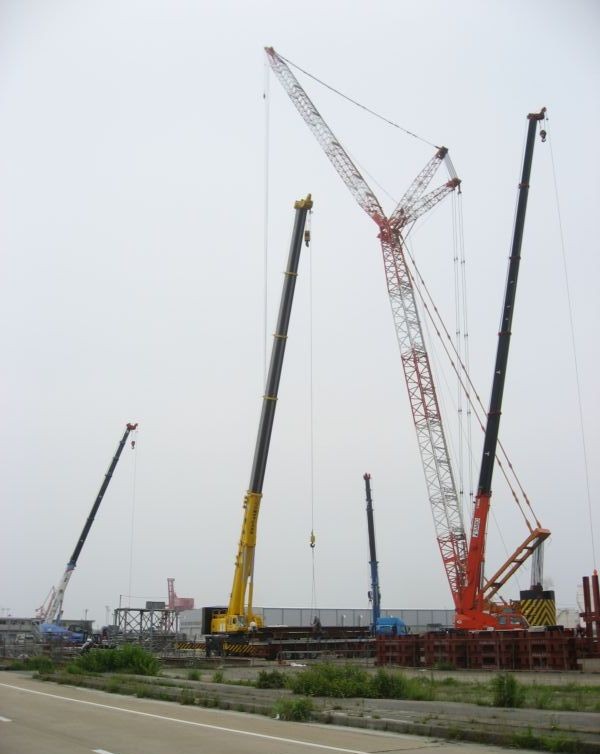
-A giant crane has been placed on site at Fukushima Daiichi to launch construction of the cover at No. 1 plant's reactor building. (See the APR YouTube Channel for videos about this covering.) Sections are now being assembled at Onahama Port for shipment to Fukushima Daiichi.

3:25 PM Eastern Tuesday June 28, 2011
ATOMIC POWER REVIEW
Read More
Posted in "fukushima daiichi" "tepco" | No comments

Friday, 24 June 2011

Fukushima Daiichi Update: Friday, June 24, 2011

Posted on 18:00 by Unknown
FUKUSHIMA DAIICHI ACCIDENT RECOVERY UPDATES...

TEPCO continues to reduce rates of water injection. Here are the injection rates, and feed nozzle / lower head temperatures at most recent update.

No. 1: 3.6 m³/hr; 119C/103C
No. 2: 3.5 m³/hr: 109C/110C
No. 3: 9.1 m³/hr: 151C/122C

At last report TEPCO calculated the buildup of roughly 400 tons of water per day due to the feed and bleed cooling.

Work in No. 2 reactor building continues. Not only has the temporary RPV pressure gauge been installed but also the nitrogen purge line to the dry well is now in place. Below is a TEPCO press release photo showing the equipment rack where the temporary gauge is installed, and the tripod for the television camera that transmits a view of the gauge to the TEPCO headquarters on site.


Also at No. 2 plant... The T-Hawk remote helicopter had an emergency, forced landing on the top of No. 2 plant's reactor building. Below is a photo showing the helicopter sitting on the roof. The helicopter was being used to sample particulate matter at the opening in the side of No. 2 reactor building according to TEPCO.


In a similar vein, TEPCO has sampled the air and any emissions above No. 1 reactor building using a concrete pumper truck modified for the job; this operation on the 23rd is seen below in another TEPCO press photo.


TEPCO continues rapidly to develop its plan to erect the first-style (as we are calling it here) containment structure, sometimes referred to as the 'fabric enclosure,' around No. 1 building and a few more details are now available. The steel structure will be supporting large sheets of fabric, now announced as being a polyester fiber fabric coated with vinyl chloride resin. This membrane will keep in any radioactive (or other) dust and gas, to be handled by an internal air filtration system capable of handling 40,000 m³/hr of air. The sheeting will of course keep out rain, snow and wind to allow the start of work inside. Much later on, a much more solid type of structure will be built at each reactor building when the preparations for defueling begin. TEPCO expects this first fabric enclosure to be complete at No. 1 plant by the end of September.

Make sure to look at the Atomic Power Review YouTube Channel (link at right of APR page) for the videos showing this structure in animation/CGI produced and released by TEPCO for the media.

Further dampening any thoughts of spent fuel pool criticality ... or prompt criticality... is a sampling run done on the spent fuel pool water at No. 1 plant on June 22. Below are the isotopes measured, their half lives, and concentrations:

Cesium 134 / half life ~2 years / 12,000 Bq/cm³
Cesium 137 / half life 30 years / 14,000 Bq/cm³
Iodine 131 / half life ~8 days / 68 Bq/cm³

Note the tiny concentration of the short-lived I-131, and the high concentration of long-lived fission product isotopes. At the first take this seems quite out of proportion if spent fuel pool criticality had been achieved recently.

At last report TEPCO calculated that its contaminated (on shore) water treatment system had processed ~2,489 tons of water. Problems with the system in terms of pre-operation valve lineups (throttling valve positions) seem to have been fixed so that the cesium adsorption portion of the system will now operate as planned. Meanwhile, TEPCO is working on desalination components in view to an end of completing the recycling of cooling water for the cores.

These are the updates for now; I will be posting an article over the weekend covering some observations, and things we can expect, concerning the future recovery actions at the site.

9:55 PM Eastern Friday June 24, 2011
ATOMIC POWER REVIEW
Read More
Posted in "fukushima daiichi" "tepco" | No comments

Tuesday, 14 June 2011

Fukushima Daiichi update: Tuesday June 14, 2011

Posted on 18:09 by Unknown
Developments of note at Fukushima Daiichi over the last two days...

TEPCO has begun operations with the previously mentioned system to remove contaminants from the seawater which is inside the breakwalls, and silt fences, in order to help prevent spread to the outer waters.

TEPCO has also begun intermittent operation of the first system set up to decontaminate water in the various onsite buildings. Various parts of this system, pictured previously on this site, are being tested separately and then in conjunction, first using plain water and then using low-level contaminated water. TEPCO's plan indicates that the whole system is to be in operation decontaminating water by the 18th of June, if all goes as planned. This system, contracted to Kurion, is only the first; the larger and more capable system contracted to AREVA has not yet begun construction.

Contaminated water is being pumped from No. 3 reactor building to the rad waste storage facility as this is written. This is part of the ongoing general move to get access to the turbine buildings at all three affected plants in order to restore cooling.

Water injection to the reactor cores at all three affected plants continues essentially as before, using the feed lines and at roughly the same rates. However, temperature on the No. 3 plant, which had been rising steadily, has now begun to decrease again with the most recent pressure vessel lower head temperature reading we have being about 161C which is ten degrees or so lower than when we last updated on this site. Water injection at this plant is actually down very slightly to 11.2 cubic meters per hour at last measurement.

In the interest of completeness, as we've detailed before, work continues at No. 2 and No. 3 plants to gain access to the reactor buildings to install new water level and pressure gauges, and to allow for nitrogen injection to the dry wells. To this end the atmospheric work at No. 2 continues, while just recently TEPCO used a concrete pump truck to extend a sampling probe over the No. 3 plant's reactor building. TEPCO press photo of this operation is below.


According to TEPCO, today a remote helicopter was used to conduct further detailed surveys around the No. 1 reactor building as serious preparation work is now underway to construct the temporary contamination shield cover for this building. This is the first of two different types of enclosures that will eventually cover all of the reactor buildings on site; first, this temporary style and later a much sturdier and heavier type which will be that which encloses the buildings while the reactors are opened and defueled.

The preparation for installation of these first style enclosures is fairly elaborate. In addition to surveys on the ground, TEPCO has, as mentioned, used air surveys and laser imaging to obtain exact dimensions. Here are two images showing steps in the laser imaging and dimensioning process, from TEPCO press releases. Both show No. 1 reactor building.

Above is an external view of the reactor building of No. 1 plant as it is now, and below is an image with the new enclosure added. Click both to enlarge.


Below is a VERY large image (when clicked) of the reactor building enclosure, which is exceedingly well detailed and worth close examination.


Below is a scale model TEPCO and its contractors have developed of the reactor building first style enclosure. Again, courtesy TEPCO.


And finally we have a TEPCO press photo of an actual reactor building enclosure being test assembled at Onahama port, in practice for installation at the Fukushima Daiichi site.


Shortly at the Atomic Power Review YouTube Channel we will have some TEPCO press release videos showing the survey and construction process for the erection of these first-style reactor building enclosures. Click here to see the APR YouTube Channel.

9:40 PM Eastern Tuesday 6/14
ATOMIC POWER REVIEW

UPDATE: Just added this morning is a new TEPCO video showing the radiation survey work inside No. 3 reactor building on June 9th. Look at the APR YouTube channel now to see it. Link above, and always in red on the right of APR's page.
Read More
Posted in "fukushima daiichi" "tepco" | No comments

Saturday, 11 June 2011

Fukushima Daiichi update: Saturday, June 11, 2011

Posted on 18:51 by Unknown
It has been three months since the Great East Japan Earthquake today. Also, then, as a result three months since the initiation of the Fukushima Daiichi Accident by the tsunami which resulted from the earthquake and which inundated the site. The tsunami then caused what in many quarters is recognized now as the classic long-term SBO event but extended to a point not previously imagined without either AC or DC power on site, and with further equipment derangement than generally imagined due to the tsunami waters which overran what had been assumed to be worst-case-preventive defenses. Accident recovery has been hampered by the hydrogen explosions in the reactor buildings, which from the explosion in No. 1 building led to many further site complications due to debris from one plant interfering with actions at other plants, thus causing a complicated interrelation of cause and effect sequence and decision making not perceived as probable in design basis accident analysis. While many of the events on site have actually been exactly predicted -- even down to roughly the hour or two hour event times -- by previous accident analysis studies (mostly under the auspices of Oak Ridge National Laboratory) many of the complicating factors were not. Just as TMI-2 led to a re-evaluation of how many seemingly unrelated existing flaws both in personnel and equipment can lead to an accident that essentially fills a DBA scenario without being a classic DBA event, so now does Fukushima Daiichi cause the nuclear industry to widen its scope particularly and thoroughly on multi-reactor nuclear generating sites where the reactor plants are closely spaced, or worse, immediately adjacent. This is not by any means the sole area to be studied, but it fairly jumps out at the investigator at even the most cursory examination. With that, here are the most recent details from Fukushima Daiichi.

TEPCO is now testing its large water purification facility, assembled over the last week or so. TEPCO still intends to have this equipment functioning within the next week.

Water injection rates to the reactor plants remain unchanged. Temperatures at No. 1 and No. 2 plants are stable, but No. 3 continues to drift upward, with bottom vessel head temp at last report being 189.2C (372.6 F).

Today, in the effort to gain working access to all reactor buildings for restoration of pressure and water level detection, and restoration of spent fuel pool systems, TEPCO finally opened up the double air lock doors at No. 2 plant and began working on filtering the air. In No. 3 plant, gamma camera surveys were conducted to map out the areas of high radiation in preparation for the aforementioned events and for the preparations for nitrogen injection to the primary containment. Areas of up to 10R/hr were found in No. 3 plant's reactor building. Nitrogen injection to No. 1 plant still continues, only rarely interrupted due to outage or nitrogen generator problems so that at the moment TEPCO estimates that over 43,000 cubic meters of nitrogen gas have been injected to the dry well for the purpose of inertion (against hydrogen gas combustion / explosion.)

Personnel have entered No. 4 plant as noted earlier to support the spent fuel pool, and some new TEPCO press photos are now available. These were taken on June 9th and 10th. First, the fourth floor view:


Next, water treatment equipment in No. 4 reactor building.


The damage seen above is considered by TEPCO to be serious enough to hinder its attempts to restore the original spent fuel pool systems for the purpose of cooling the spent fuel pool. Not only is there debris everywhere, but there is also piping damage that TEPCO apparently had expected not to find.

TEPCO continues to bring in water storage capacity as rapidly as possible. The large tanks mentioned on this site a short while back are now arriving on site and are being mounted and connected. First of our two TEPCO press photo displays is one of the tanks during the night-time shipping routine, chosen to avoid obstruction of roads and thus daytime traffic.


Below, the installation of the tanks at the Fukushima Daiichi site.


These are the most important confirmed details at the moment. More to come.

10:25 PM Eastern Saturday 6/11
ATOMIC POWER REVIEW
Read More
Posted in "fukushima daiichi" "tepco" | No comments

Wednesday, 8 June 2011

Fukushima Daiichi: Wednesday update June 8

Posted on 12:17 by Unknown
First.. there are reports circulating in the press, seemingly particularly on anti-nuclear sites and anti-nuclear leaning big media that the Japanese are submitting a report to the IAEA that "admits" total core melt and some core material exit from the reactor pressure vessels at all three affected reactor plants.

This has been reported on this blog for months. It is not new; it is not news.

This blog may have been the first to begin quoting ORNL SBO scenario analysis indicating core material falling below the core support plate and damaging, first, lower vessel head penetrations ... which reports seemed likely to match up well with the events known at that time to have occurred and to be occurring at Fukushima Daiichi. It was probably also the first to speculate on the possible failure of the support plate and quenching of the core material in water still contained in the bottom plenum, among other things, a long while back. Readers of this blog were already aware of these kinds of possibilities and events and, upon reading this report, would find nothing new or surprising in it. This gives our readers both pro-nuclear and anti-nuclear a definite leg up.

Now, briefly, there has also been an oil spill reported at Fukushima Daini. Repeat-- this is the other plant, further south, with four reactors. This oil spill is under control and is minor.

Getting back to Fukushima Daiichi; below are the promised photos of the initial setup TEPCO will use to decontaminate water on site as early as next week if all goes well. We will show the components of this system in order. All photos courtesy TEPCO (Tokyo Electric Power Company.)

First, the oil separation tank.


Next, two views of the cesium absorption towers:


Next, decontamination equipment (TEPCO indicates this to be nuclide coprecipitation and absorption equipment):


The next .. and last .. steps shown are desalination and water treatment, although there is planned to be one further desalination and treatment step beyond this which is not yet built.


TEPCO has begun installation of 32 steel support beams below the spent fuel pool in No. 4 plant at Fukushima Daiichi. More TEPCO press releases show the location of this work, the beams as received at the plant, and two of them actually installed helping support the spent fuel pool itself.


3:35 PM Eastern Wednesday June 8, 2011
ATOMIC POWER REVIEW
Read More
Posted in "fukushima daiichi" "tepco" | No comments

Sunday, 5 June 2011

TEPCO Video: Dust inhibitor operations

Posted on 02:47 by Unknown
New TEPCO release depicts dust inhibitor spraying operations at No. 2 plant, Fukushima Daiichi site.

DUST INHIBITOR OPS

As with previous links of this nature this video is hosted on the new Atomic Power Review YouTube channel, started up May 17th of last month.

5:50 AM Eastern Sunday June 5, 2011
ATOMIC POWER REVIEW
Read More
Posted in "fukushima daiichi" "tepco" | No comments

Friday, 3 June 2011

Fukushima Daiichi update: Friday June 3

Posted on 17:30 by Unknown
TEPCO is rapidly running out of room for contaminated water, due partly to water injection and partly to rain at the site. The company has announced that beginning tomorrow it will begin shipping two sizes of tanks (100 and 120 cubic meters in volume) from Tamada Kogyo Corporation's plant in Tochigi Prefecture to the Fukushima Daiichi site for installation. These will supplement all the other tanks being installed on site, and the "mega float" now firmly secured to the pier at the site. The company expects most of the shipments to be performed at night, and expects about six of the large units per day to be shipped from now until early July, and four units per day of the smaller size from the middle of June through the middle of August. This will vastly increase the capacity for contaminated and then later for cleaned-up water on site. NHK is carrying the line that TEPCO has reported having as much as 105,000 tons of contaminated water on site right now, in all of the various affected and damaged buildings, and tunnels and installed tanks as well as the rad waste building. Filtration equipment may be on line as early as June 15.

Below, some of the temporary tanks installed near Units 5 and 6 in a TEPCO release.


And some further... and much larger (click to expand) TEPCO press photos showing the interlinked tank setups. Note that these are NOT the same as the tanks mentioned in the opening paragraph of this post. These are the previously designed tanks for temporary storage, and the tanks now ordered will vastly exceed these in total capacity later on when fully installed.


Water injection (all feed line injection) to No. 1 and No. 2 plants stands at about 5 cubic meters per hour, both, and both have feed nozzle temperatures right at about 110C. No. 3 plant's injection rate is 11.5 cubic meters per hour with a feed nozzle temperature of 150C.

TEPCO, no longer believing the previous reactor vessel pressure indication, has installed a temporary gauge at No. 1 plant which will be viewed remotely by a temporary television camera. TEPCO has noted for some time, apparently, that feed pump discharge pressure was widely disparate from the indicated instrument pressure and has made this move to correctly determine the value. TEPCO's press release (handout) indicates this work will also be performed identically at the other two reactors affected.

There is a small flap going on among various entities in Japan over cylinder liner failures in some EDG's. One at the fast breeder Monju plant has been found with failed liners, and investigation has shown that liners of certain original vintage (made Feb '87 through May '89) may have excessive lead content and thus be weak... although a note was made about jacking the liners without adequate monitoring leading to excessive forcing. As far as TEPCO is concerned, only Fukushima Daini No. 2 and No. 4 plants have similar diesels with similar liners, so that the problem appears not to be wide spread.

9:00 PM Eastern Friday June 3, 2011
ATOMIC POWER REVIEW
Read More
Posted in "fukushima daiichi" "tepco" | No comments

Wednesday, 1 June 2011

Fukushima Daiichi update June 1st

Posted on 05:20 by Unknown
There are a number of updates from the Fukushima Daiichi site to relate. None serious, but several noteworthy ... if only due to their being carried by major media outlets. We'll relate these things and put them in perspective.

-Radiation levels in the seawater outside the No. 1 through No. 4 plants have gone up somewhat in recent days, and water levels in the turbine buildings have been reported as rising faster. There is a typhoon in the vicinity which has been causing a lot of rain (as viewers of the Fukuichi camera and its predecessor can also assert) and it's speculated that this is one major cause for spikes in readings of some isotopes immediately offshore. As a response to this, and further as a hedge against the threat of running out of temporary contaminated water storage capacity, TEPCO is going to quickly install a filtration system for water in the area outside No. 1 through No. 4 plant seawater inlet gates, which is all inside the silt fences previously installed. Below is a TEPCO press release illustration showing one of the filtration tank units (supplied by Toshiba) and the general expected setup.

And just in, off the TEPCO wires.... this view taken today of one of the tanks actually installed and connected:


-Injection rates at the three reactor plants with cores installed continue to be decreased by TEPCO, as TEPCO both transitions over from the use of firefighting supply lines to the feedwater lines, and attempts to optimize injection rate to only that required for safe cooling to reduce water buildup in the reactor and turbine buildings. No. 1 plant is now at 5 cubic meters per hour, while No. 2 is at 4.9 cubic meters per hour; both are operating with injection only on the feed line. No. 3 plant is also only on the feed line and now is down to 11.5 cubic meters per hour. Temperatures at all three plants are slowly lowering as of now; readers are referred to the decay heat graph posted on this blog a few days back for comparison of the inferred heat generation decrease over time with the lowering cooling water injection rates.

-Remotely controlled construction equipment accidentally damaged an oxygen storage cylinder in the vicinity of No. 4 plant the day before yesterday. No one was injured; incredibly, there are still images floating around the net from the new Fukuichi 24-hour onsite camera that show the blast. Dramatic, if small, the blast caused no damage which has been reported by TEPCO or its contractors.

-There is a report circulating that while TEPCO told the Japanese Government that it had suspended seawater injection to the core of No. 1 plant at Fukushima Daiichi in the serious hours immediately after the typhoon, an on-site supervisor in fact made certain that seawater injection continued uninterrupted. (Government permission was required for this step, and there was uncertainty about it having been received, apparently.) While this caused a bit of a media stir in Japan, Prime Minister Naoto Kan has gone on the record as saying that this should not result in punishment of this particular supervisor. (He made the right call, by the way, in continuing injection with whatever water source he had available without outside non-expert interference.... APR opinion.)

-A brief oil spill outside No. 5 and No. 6 plants, found on the 31st, has resulted in the application of cleanup material (absorption) to the shore line, and the rapid installation of an oil fence. TEPCO is cleaning up this minor spill as this report is written. Below, TEPCO press photo showing the oil sheen on the water surface.


-TEPCO continues to experiment with the installed, recirculating cooling systems for the spent fuel pools at all three plants. Hydrazine addition (to prevent oxygen corrosion of the fuel elements) is being performed occasionally at the spent fuel pools as TEPCO deems necessary.

These appear to be the most important updates at the moment. There are a large number of projects underway right now at the site, and we'll report here on further developments as needed.

8:55 AM Eastern Wednesday June 1, 2011
ATOMIC POWER REVIEW
Read More
Posted in "fukushima daiichi" "tepco" | No comments

Monday, 30 May 2011

Fukuishi LIVE Fukushima Daiichi Camera

Posted on 20:37 by Unknown
A twenty-four hour a day live camera is now being used at the Fukushima Daiichi Nuclear Power Station. Below is the link:

FUKUICHI LIVE CAMERA

Note the small map, showing clearly the area of coverage of the camera.

11:40 PM Eastern Monday 5/30
ATOMIC POWER REVIEW
Read More
Posted in "fukushima daiichi" "tepco" | No comments

Sunday, 29 May 2011

Fukushima Daiichi... Sunday 5/29

Posted on 17:39 by Unknown
Some updates from Fukushima Daiichi...

-TEPCO does not at this time believe that the rain and wind from the approaching tropical storm will cause any severe problems at the site. TEPCO had sandbagged a number of electrical distribution panels, and has taken other measures to ensure continuity of AC power during the heavy weather.

-Cooling injection at No. 3 plant is now solely through the feed system at about 13.5 cubic meters per hour.

-Feed system cooling injection has begun at No. 2 plant, at a rate of 5 cubic meters per hour. This supplements the 7 cubic meters per hour from the fire extinguishing line in use previously.

-It would appear that further outflow.. from source or sources not yet determined.. is driving up contamination rates again inside the near breakwater. TEPCO is investigating the exact source.

-There is some press about the temporary loss of circulating system (seawater) at No. 5 plant driving up plant and spent fuel pool temperatures. There was no serious effect, and plant temperature and spent fuel pool temperature are back on the way down. It appears that no pump was running for as long as 15 hours. The loss of the pump was first detected at 21:24 on May 28th, according to TEPCO, and work on replacement began at 8:12 the morning of the 29th. At 12:31 the newly installed, spare pumps were started and at 12:49 the normal cooldown lineup was re-established, and cooling of the reactor plant began again.

-All four plants, No. 1 through No. 4 now have their spent fuel pool cooling systems restored. These are being used to inject cooling water as needed at the moment, with no recirc cooling capability yet. Recirc cooling (as designed) is expected to be operational for all four plants sometime in July. This removes the need for the long arm concrete spray trucks on a continuous basis, although they remain on site (moved to a safe location due to the impending storm) as backups to the installed (original) systems for spent fuel pool cooling.

-For reference.. and because we have not mentioned it lately.. with only a couple brief interludes due to equipment malfunction, TEPCO continues to pump nitrogen into the dry well of No. 1 plant. At this time, the total injected volume of nitrogen to this plant stands at about 34,300 cubic meters (total from April 7 until May 29.)

9:00 PM Eastern Sunday 5/29
ATOMIC POWER REVIEW
Read More
Posted in "fukushima daiichi" "tepco" | No comments

Wednesday, 25 May 2011

Fukushima Daiichi details... Wed. May 25

Posted on 08:51 by Unknown
There are two news stories of interest coming out of Japan at the moment. We'll tackle them in our usual fashion.

First, TEPCO is now reporting failures at the bottom of all three reactor pressure vessels; this is being carried for the moment only on the major Japanese news media and has not appeared in TEPCO's press material as of yet. I reported on this blog a very long time ago the high percentage of likelihood during a long-term SBO event that damage at the bottom reactor pressure vessel head would occur. I believe I even mentioned this on the radio interview that Fintan Dunne performed, wherein I was a guest. It should be noted that TEPCO is reporting equivalent leakage from a single theoretical hole, and that the real failures are probably around control rod drive penetrations, from some cracks, and maybe around pipe penetrations so that there isn't one single large hole but a scattering of smaller failures.

A long time back this blog was the first to introduce to the general public the 'inside' term of "feed and bleed" to describe what was occurring at Fukushima Daiichi; that essentially being the cooling of the cores by continuous injection of water from new sources, with water loss occurring at some or other point or at multiple points. This is of course different from recirculating cooling, where water is moved in a loop. So, then, for readers of this blog this is not an entirely new revelation in the sense that for a long time we've been wondering exactly how the water was getting out of the reactors.

We knew where it was going long before this revelation (if it really is revelation) by TEPCO. First, we saw contaminated water in the turbine buildings. Then we saw it in trenches outside, and in the seawater. Of course, early on everyone suspected it was getting to these places after having started in the reactor buildings unless there were piping failures in the turbine building that were releasing water from the reactors (one example, discounted early, could have been stuck open MSIV or Main Steam Isolation Valves.)

In summary, then, it's not really a surprise, given the known facts about long-term SBO accidents (core damage in hours, core melt through pressure vessel as a possibility starting after ten hours or so, which varies by plant and by actual timeline of events) and the known release of water if there is in fact serious failure at the reactor pressure vessel lower heads, or possibly the area of the vessel just above them. TEPCO performed a number of steps early on that made us suspect that TEPCO suspected serious core damage; for example, the very early drywell flooding is something you see when the operators are trying to prevent or delay failure of the pressure vessel by its contact with melted fuel. Only later did drywell flooding come about again, this time as a part of the attempt to fully cool the cores; early on it was an accident mitigation strategy and not a recovery strategy. Events at Fukushima Daiichi, studies done over many years (primarily by ORNL), and operator actions at Fukushima Daiichi have pointed to serious failure in the pressure vessels or piping for some time now.

Now, the second news item; TEPCO is reporting data that indicates that there may have been a pipe failure at No. 3 plant in the HPCI (High Pressure Coolant Injection) system. TEPCO is denying at the moment that the earthquake caused a pipe failure; in fact, given the data we have right now we cannot assure that the HPCI system was the failure point. It appears that initiation of the HPCI system occurred shortly before a major drop in pressure in the primary plant. Some writers are saying that this is de facto proof that there was a pipe failure in the HPCI system, and are assuming the earthquake caused it. However, until the system itself is inspected this is not a sure bet; for example, no one has ruled out a stuck open relief valve or any other such possibility. (There are some anomalies in data recorded on relief valve tailpiece RTD's which we've noted here once or maybe twice; these are what you would use to detect a stuck open relief, or a relief that lifted at all for that matter.)

The reason this is important theoretically is that if it were true you would then have to consider the plant also in a LOCA scenario (Loss Of Coolant Accident) in combination with the SBO scenario. This seems a small difference but is a major difference in the analysis of how to handle the situation, and how to prevent an occurrence in the future. But before we jump to conclusions we need more solid data from TEPCO who, to repeat, is not saying that the earthquake damaged the system as of yet. We will certainly keep an eye out for clarification on this issue.

More to come later on today.

12:45 PM Eastern Wednesday 5/25
ATOMIC POWER REVIEW
Read More
Posted in "fukushima daiichi" "tepco" | No comments

Monday, 23 May 2011

Fukushima Daiichi update: Monday, 5/23

Posted on 11:11 by Unknown
As has become the case in the last few weeks, with the plant conditions stabilized, the train of press releases and other news items from Fukushima Daiichi grinds to a halt over the weekend, and then starts up to full speed again on Monday. Of course, work at the site, at TEPCO HQ for planning, and at Japan's NISA and other offices doesn't stop over the weekend, meaning that there is usually a lot of catching up to do on Mondays. This Monday is no exception.

First, keeping up with a trend we've been following the last several days on this site, it seems TEPCO is continuing to back off injection rate at No. 3 plant. Today we have the news that TEPCO reduced the injection rate through the firefighting line from 6 to 5 cubic meters per hour at 11:31 AM on the 23rd, and then further reduced it to 4 cubic meters per hour at 2:08 PM. Thus, the total injection rate is the combined 4 from the firefighting line and the 12 through the feed line giving 16 cubic meters per hour... still more than the 6 and 7 cubic meters per hour at No. 1 and No. 2 plants, respectively. Temperatures at last available reading were still stable on No. 3 plant.

Some other points of news from the site, briefly:

-TEPCO has begun performing air sampling around and above the reactor buildings, to check for airborne release. This will be reported to NISA.

-TEPCO has launched its effort to gusset, or support, the spent fuel pool area of the No. 4 reactor building. Shielding has been brought in to reduce exposure to the workers who will begin installing steel columns to hold up the pool, whose floor will be reinforced (from underneath, not from inside) with a layer of concrete.

-TEPCO is expected to submit a report to the Japanese Government today which will apparently assert clearly that there was NO damage to the reactor plants as a result of the Great East Japan Earthquake. Plant data charts and tapes, and debriefing of employees are TEPCO's evidence. The damage sequence began ... as this blog has asserted time and again since being among the very earliest to do so ... when the tsunami hit and triggered an essentially unrecoverable SBO accident scenario. We will have details of this report here when it comes out.

Similarly there are reported to be a number of new photos and a video which TEPCO will release at some point, and those will either appear here or else on the Atomic Power Review YouTube channel.

-TEPCO has decided that reducing the temperature of the spent fuel pool in the No. 2 plant will drastically lower the ambient humidity in the reactor building... and so will install a new heat exchanger for the spent fuel pool's cooling as soon as possible. Reduction in the humidity will make work in the building possible by people rather than just by remote controlled robots.

Finally, for this post... Many people have commented and e-mailed about the report that TEPCO operators shut off the isolation condenser cooling system that was in use at No. 1 plant after the loss of power, when it was the primary heat removal system in such a situation. I have not commented on this as of yet... as have I also not commented on NHK News saying that it has a "copy of the Fukushima Daiichi Operating Manual" and can prove improper operation... because there simply are not enough solid details available yet. On the No. 1 plant cooling issue, supposedly the operators shut the system off and then it took several hours to restore any sort of core cooling. On the NHK-asserted improper plant ops issue, supposedly the operators didn't vent the containment anywhere near early enough and violated operating rules during the casualty by not doing so.

Both of these are serious accusations. Apparently TEPCO is looking seriously into the first, while it has not commented on the second. Frankly, I don't know what documents NHK has in its possession... and if someone unfamiliar is reading any sort of actual operations literature it's sure to be misinterpreted.

It is not my desire to "blow off" accusations, but in both cases we simply do not have any solid information from TEPCO on validity or effect. Until we do there's little point in analyzing such things and playing the blame game. If it comes out that TEPCO operators were incompetent, I'll certainly be printing that here because first and foremost in importance for the long-term is to understand all of the contributing actions and events that led us to the Fukushima Daiichi Accident as it stands right now. Operator error almost always figures into accidents; the question here is how, and when.... as long as there is more proven than an "if."

2:45 PM Eastern Monday 5/23
ATOMIC POWER REVIEW
Read More
Posted in "fukushima daiichi" "tepco" | No comments

Saturday, 21 May 2011

Brief Fukushima Daiichi update- Sunday 5/22

Posted on 19:59 by Unknown
As reported on this blog on April 23, TEPCO has (again) noted the discovery of radioactive debris on the Fukushima Daiichi site which is emitting between 90 R/hr and 100 R/hr. This debris is near the No. 3 plant reactor building, reportedly, and as noted before is the highest dose rate found on site yet.. that is, outside of the plant buildings, anyway.

TEPCO has reduced the feed rate to No. 3 reactor again. According to the TEPCO press release, flow rate through the feed line has remained constant today at 12 cubic meters per hour, but feed flow through the firefighting connection has been reduced in steps. At 5:39 AM this was reduced from 9 cubic meters per hour to 8; at 8:43 AM to 7; and at 11:54 AM finally to 6 cubic meters per hour. Thus, as of now the total feed rate to No. 3 is 18 cubic meters per hour. No. 1 plant, for comparison, is at 6 cubic meters / hr while No. 2 plant is at 7 cubic meters / hr.

The "mega-float" barge is now at Fukushima Daiichi.

12:05 AM Eastern Sunday 5/22
ATOMIC POWER REVIEW
Read More
Posted in "fukushima daiichi" "tepco" | No comments

Friday, 20 May 2011

TEPCO Board Meeting

Posted on 02:32 by Unknown
TEPCO has made a press release stating the fact that at a meeting of the board of directors of the company, TEPCO has decided to decommission Fukushima Daiichi No. 1 through No. 4 and has also decided not to build the planned No. 7 and No. 8 plants at the site.

That's old news... look at this post from this blog dated April 17.

What is interesting about this press release is the fact that Fukushima No. 5 and No. 6 are not mentioned. I noted in the post I linked above that the long-term TEPCO plan released for the press did in fact mention defueling of No. 5 and No. 6 plants. TEPCO has, as of yet, not come out one way or another solidly in a public manner with a determination on these two plants. The TEPCO plan document (pdf) I referenced in the above post included 5 and 6 but this was never otherwise publicly commented on by TEPCO that I saw; now, this report from the board of directors totally fails to mention these two plants one way or the other except to say that they are successfully in cold shutdown and are compared in status to the four plants at Fukushima Daini.

Can it be that TEPCO is still considering returning these two plants to operation? That would be an incredible revelation -- not for any technical reason, but for the simple fact that TEPCO would obviously be so totally clueless about public perception if that were their thinking. Surely the Fukushima Prefectural Government will never allow it.

Below, the full text of the TEPCO press release, dated May 20, 2011.

We deeply apologize for the anxiety and inconvenience caused to local
residents near the site and broader society due to the accident at
Fukushima Daiichi Nuclear Power Station caused by the Tohoku-Chihou-
Taiheiyou-Oki Earthquake that occurred on March 11 2011.
Today, we held a Board of Directors meeting where it was decided to
decommission Units 1 to 4 and abolish plans to build Units 7 and 8 at
Fukushima Daiichi Nuclear Power Station.
Fukushima Daiichi Nuclear Power Station was severely damaged due to the
Tohoku-Chihou-Taiheiyou-Oki Earthquake and the tsunami that followed
after. In particular, the melting of the fuel pellets inside Units 1 to
4 caused them significant damage. This was followed by a series of
explosions. Hence, the decision to decommission them was made.
Furthermore, in consideration of the societal impact, we believe that
it would be very difficult to gain acceptance from local residents with
regards to building additional Units 7 and 8 and therefore, decided to
abolish their construction plans.
In regard to procedures for filing applications to the government in
connection with the said determination to decommission and abolish, we
will continue to consult with the government and relevant authorities.
Moreover, the reactors of Units 5 and 6 of Fukushima Daiichi Nuclear
Power Station, together with the reactors of Fukushima Daini Nuclear
Power Station, have been successfully brought to a cold shutdown.
However, a detailed investigation is still pending. For the time being,
we will take appropriate measures in a timely manner to keep the reactors
in a cold shutdown.


5:40 AM Eastern Friday 5/20
ATOMIC POWER REVIEW
Read More
Posted in "fukushima daiichi" "tepco" | No comments
Older Posts Home
Subscribe to: Posts (Atom)

Popular Posts

  • Steam Generators: Design and details
    A recent NRC blog post ( see here ) brings up a matter that has come into focus of late at San Onofre Nuclear Generating Station in Californ...
  • The 136th Carnival of Nuclear Bloggers
    I find myself on this December 23rd, making the Atomic Power Review entry hosting the 136th Carnival, thinking about all of the great achiev...
  • Nuclear Icebreakers 101
    An addendum for National Nuclear Science Week - Day 3 In the previous post I gave the briefest overview of the history of the Russian fleet ...
  • Carnival of Nuclear Bloggers comes to APR
    60th Carnival of Nuclear Bloggers Atomic Power Review is very proud to host, for the first time, the rotating Carnival. This feature present...
  • San Onofre Nuclear Generating Station Virtual Tour
    Press release from Southern California Edison, courtesy Jennifer Manfre, Senior Manager, Media Relations for SCE. --------------------------...
  • The effect of big media: A real conversation
    I recently had a conversation with a friend of mine that interestingly turned nuclear. She's married, mother of one beautiful nine month...
  • 60th anniversary of EBR-I power generation
    Yesterday and today mark an important event in nuclear energy history; these two days are the span during which the EBR-1 reactor plant, whi...
  • The 84th Carnival of Nuclear Bloggers
    Once again Atomic Power Review is proud to host the rotating Carnival of Nuclear Bloggers - this, the 84th edition. This feature travels aro...
  • SCE Demands Mitsubishi Allow Contractually Mandated Audit
    The following press release was received last evening from Southern California Edison. ---------- Media Contact: Media Relations, (626) 302-...
  • Fukushima Daiichi: Reactor update
    Two news reports on the reactors (as opposed to spent fuel pools or any other portions or locations) at Fukushima Daiichi... First, TEPCO ha...

Categories

  • " fukushima daiichi"
  • "accident"
  • "alloy"
  • "ameren"
  • "american nuclear society"
  • "annealing"
  • "anniversary"
  • "ans"
  • "anti-nuclear"
  • "AP1000"
  • "arco"
  • "areva"
  • "asn"
  • "associated press" "NRC" "NEI"
  • "atomic journal"
  • "babcock"
  • "blackout"
  • "bloggers"
  • "boron"
  • "brazil"
  • "breeder reactor"
  • "breeder"
  • "browns ferry"
  • "browns ferry" "nine mile point"
  • "BWR"
  • "calhoun"
  • "callaway"
  • "carnival"
  • "chernobyl"
  • "china"
  • "chubu electric" "hamaoka"
  • "chubu" "hamaoka"
  • "chubu" "hamaoka" "tepco" "fukushima daiichi"
  • "chubu" "kyushu" "nisa"
  • "COL"
  • "commissioners"
  • "containment"
  • "contaminated"
  • "cooling"
  • "cooper" "ft calhoun" "flood" "missouri river"
  • "core damage"
  • "criticality"
  • "davis-besse"
  • "delta IV"
  • "dresden" "boiling water reactor" "containment"
  • "dry dock"
  • "dry well"
  • "earth day"
  • "earthquake"
  • "EBR"
  • "ebwr"
  • "education"
  • "elk river"
  • "embrittlement"
  • "enclosure"
  • "energy policy"
  • "equipment"
  • "fabrication"
  • "fermi"
  • "fire"
  • "flood"
  • "frontline"
  • "ft calhoun"
  • "ft calhoun" "oppd" "flood"
  • "ft st vrain"
  • "fukushima daiichi"
  • "fukushima daiichi" "BWR"
  • "fukushima daiichi" "nisa" "tepco"
  • "fukushima daiichi" "tepco"
  • "fukushima daiichi" "tepco" "dry well" "containment" "pressure vessel"
  • "fukushima daiichi" "tepco" "iaea"
  • "fukushima daiichi" "tepco" "kurion" "areva"
  • "fukushima daiichi" "tepco" "nisa"
  • "fukushima daiichi" "tepco" "nisa" "genkai" "pressure vessel"
  • "fukushima daiichi" "tepco" "nisa" "jaif"
  • "fukushima daiichi" "tepco" "nisa" "japan"
  • "fukushima daiichi" "tepco" "nisa" "jsc" "road map" "recovery"
  • "fukushima daiichi" "tepco" "nisa" "spent fuel" "pool"
  • "fukushima daiichi" "tepco" "nitrogen"
  • "fukushima daiichi" "tepco" "robot" "video"
  • "fukushima daiichi" "tepco" "tokai" "japco" "iaea"
  • "fukushima daiichi" "tepco" "tomari" "hokkaido"
  • "fukushima daiichi" "tepco" "tsunami"
  • "fukushima daiichi" "tepco" "video"
  • "fukushima daiichi" "tepco" "video" "youtube"
  • "fukushima daiichi" "TMI" "public opinion" "survey"
  • "fukushima daiichi" "video"
  • "fukushima daiichi" 7 8 plants economic plan TEPCO
  • "fukushima daiichi" cooling water release sea ocean nuclear reactor accident NISA TEPCO pit trench tunnel
  • "fukushima daiichi" nuclear reactor accident contaminated water barge Suzuran Rosatom TEPCO
  • "fukushima daiichi" nuclear reactor accident contaminated water sea radwaste condensers nitrogen hydrogen inert
  • "fukushima daiichi" nuclear reactor accident earthquake onagawa TEPCO tohoku BWR nitrogen
  • "fukushima daiichi" nuclear reactor accident IAEA TEPCO update briefing temperatures pressures
  • "fukushima daiichi" nuclear reactor accident japan update color dye containment fabric update
  • "fukushima daiichi" nuclear reactor accident leakage sea seawater contamination tunnel trench cable pit
  • "fukushima daiichi" nuclear reactor accident liquid glass sodium silicate TEPCO
  • "fukushima daiichi" nuclear reactor accident nitrogen hydrogen inert dry well drywell
  • "fukushima daiichi" nuclear reactor accident nitrogen inert radiolytic radiolysis hydrogen
  • "fukushima daiichi" nuclear reactor accident polymer leak concrete contaminated contamination reactor pressure vessel containment cooling
  • "fukushima daiichi" nuclear reactor accident seawater contamination iodine tunnel trench TEPCO NISA JAIF
  • "fukushima daiichi" nuclear reactor accident site update status project future
  • "fukushima daiichi" nuclear reactor accident sodium silicate liquid glass diagram drawing perspective pipe tunnel trench contamination sea seawater
  • "fukushima daiichi" nuclear reactor accident TEPCO NISA JAIF update
  • "fukushima daiichi" nuclear reactor accident update TEPCO JAIF NISA
  • "fukushima daiichi" nuclear reactor accident water leakage contamination workers found dead
  • "fukushima"
  • "gas cooled"
  • "genkai"
  • "genkai" "embrittlement" "brittle" "pressure vessel"
  • "genkai" "kyushu"
  • "hack job"
  • "hallam"
  • "head"
  • "hearing"
  • "hearings"
  • "higashidori"
  • "hitachi"
  • "HNPF"
  • "hurricane"
  • "hydrogen"
  • "IAEA"
  • "icebreaker"
  • "IFR"
  • "INES"
  • "injection"
  • "irene"
  • "irrelevant"
  • "jaczko"
  • "jaczko" "NRC"
  • "JAIF"
  • "japan"
  • "kurion"
  • "kyushu"
  • "laguna verde"
  • "lenin"
  • "licensing"
  • "loop"
  • "lunch"
  • "marcoule"
  • "mark I"
  • "melt"
  • "meltdown"
  • "mexico"
  • "mitsubishi"
  • "MK I" "containment" "suppression" "youtube" "video"
  • "mPower"
  • "mPower" "Bechtel" "TVA" "babcock"
  • "national nuclear science week"
  • "nei"
  • "new nuclear"
  • "NISA"
  • "nitrogen"
  • "no 5"
  • "no 6"
  • "north anna"
  • "NRC"
  • "NRTS"
  • "nuclear aftershocks"
  • "nuclear energy institute"
  • "nuclear history"
  • "nuclear icebreaker"
  • "office for nuclear regulation"
  • "op-ed"
  • "op-ed" "carnival"
  • "op-ed" "fukushima daiichi"
  • "opinion"
  • "oversight"
  • "palisades"
  • "pbs"
  • "peer review"
  • "poll"
  • "PRA"
  • "press"
  • "pressure vessel"
  • "pressurized thermal shock"
  • "primary to secondary leak"
  • "PTS"
  • "public attitudes"
  • "PWR"
  • "RBMK-1000"
  • "RBMK-1500"
  • "RBMK-2400"
  • "RBMK"
  • "reactor safety"
  • "reading list"
  • "recriticality"
  • "Reid"
  • "reporting"
  • "restart"
  • "risk"
  • "robot"
  • "rod adams" "glenn williams" "interview" "atomic show" "the street"
  • "safety"
  • "san onofre"
  • "sarry"
  • "SBO"
  • "sheldon station"
  • "shippingport"
  • "SMR"
  • "solar"
  • "songs"
  • "south africa"
  • "south texas project"
  • "spent fuel"
  • "SSBN"
  • "steam generator"
  • "steam generators"
  • "steel"
  • "stress tests"
  • "submarine"
  • "support"
  • "Svinicki"
  • "sylcor"
  • "sylvania-corning"
  • "TEPCO"
  • "tepco" "tohoku" "kyushu" "japan"
  • "TMI"
  • "tokyo electric"
  • "Toshiba"
  • "twitter"
  • "UK"
  • "update"
  • "vermont yankee"
  • "vessel"
  • "video"
  • "virgil c summer"
  • "virginia"
  • "vogtle"
  • "wash-1250"
  • "WASH"
  • "westinghouse"
  • "westinghouse" "AP1000" "NRC"
  • "xenon"
  • "youtube"
  • ANO
  • ANS
  • arkansas nuclear one
  • Babcock
  • brittle fracture
  • brookhaven
  • carnival
  • crystal river
  • decommissioning
  • earthquake
  • enriched uranium
  • Entergy
  • fintan dunne
  • FirstEnergy
  • fresno
  • fuel elements
  • fukushima daiichi
  • higashidori
  • hurricane
  • hurricanes
  • industrial accident
  • INES
  • kashiwazaki kariwa TEPCO earthquake
  • kenya
  • license amendment
  • MHI
  • mitsubishi
  • mPower
  • NEI
  • northern fleet
  • nrc
  • nuclear electricity project
  • nuclear history
  • nuclear submarines
  • onagawa tohoku leak earthquake
  • OSHA
  • oyster creek
  • palisades
  • press release
  • pressurized thermal shock
  • PTS
  • retire
  • russian navy
  • san onofre
  • sandy
  • sce
  • sherrell r greene
  • shutdown
  • SMR
  • socal ed
  • songs
  • southern california edison
  • spent fuel
  • spent fuel pool
  • spent fuel pools
  • status
  • steam generator
  • steam generators
  • surry
  • sustainable energy today
  • sylcor
  • sylvania-corning
  • TEPCO
  • tohoku electric power higashidori onagawa LOOP fuel pool cooling
  • tokyo electric power company
  • unusual event

Blog Archive

  • ▼  2013 (71)
    • ▼  October (5)
      • South Korea: Cables fail tests; Government suing ...
      • SCE Requests Arbitration in SONGS Steam Generator ...
      • SCE Demands Mitsubishi Allow Contractually Mandate...
      • Resin-based solution to Fukushima water problems
      • SCE Demands Reimbursement from Mitsubishi for San ...
    • ►  September (5)
    • ►  August (9)
    • ►  July (5)
    • ►  June (6)
    • ►  May (2)
    • ►  April (8)
    • ►  March (13)
    • ►  February (13)
    • ►  January (5)
  • ►  2012 (159)
    • ►  December (6)
    • ►  November (7)
    • ►  October (13)
    • ►  September (7)
    • ►  August (19)
    • ►  July (15)
    • ►  June (16)
    • ►  May (17)
    • ►  April (13)
    • ►  March (14)
    • ►  February (14)
    • ►  January (18)
  • ►  2011 (270)
    • ►  December (22)
    • ►  November (21)
    • ►  October (20)
    • ►  September (21)
    • ►  August (17)
    • ►  July (23)
    • ►  June (24)
    • ►  May (44)
    • ►  April (78)
Powered by Blogger.

About Me

Unknown
View my complete profile